
Last Updated: October 23, 2026
Quick Summary
The best coffee for camping trips balances taste quality, weight and packability, and brewing simplicity. For ultralight backpacking, instant coffee is lightest; for car camping, ground coffee or whole beans with a French press or pour-over produces better flavor; for weekend trips, instant or single-serve sachets offer a practical middle ground.
- Instant coffee makes roughly eight cups per ounce and requires only hot water and a cup
- A collapsible silicone pour-over cone weighs less than two ounces and produces one to two cups of good coffee
- Ground coffee should be stored in airtight containers or small ziplock bags with air removed
- The standard ratio is one rounded tablespoon of ground coffee per six-ounce cup of water
- Paper filters are the best environmental option and weigh almost nothing to pack out
Table of Contents
- Best Coffee for Camping Trips: Quick Comparison
- How to Choose the Right Coffee for Your Camping Style
- Best Instant Coffee for Camping
- Ground Coffee and Whole Beans: Freshness vs. Weight
- How to Make Coffee While Camping: Brewing Methods That Work
- Camping Coffee Maker Options: Lightweight and Durable
- Coffee to Water Ratio for Camping: Getting the Strength Right
- Waste and Leave-No-Trace: Packing Out Your Coffee
- Frequently Asked Questions
Best Coffee for Camping Trips: Quick Comparison
The best coffee for camping trips balances three competing demands: taste quality, weight and packability, and brewing simplicity. What works at your kitchen counter falls apart at 8,000 feet or in a rainstorm. This guide from Hot Chick Coffee breaks down the options that actually perform in the field, organized by how you camp and what matters most to you.

A backcountry ultralight trip demands a different approach than car camping where weight is irrelevant, and a week-long expedition has different freshness requirements than a weekend getaway. Below, we'll show you how to choose the right coffee for your camping style, compare brewing methods that work outdoors, and share the ratios and techniques that separate mediocre camp coffee from the good stuff.
| Camping Style | Best Coffee Type | Brewing Method | Key Advantage |
|---|---|---|---|
| Backcountry ultralight | Instant coffee | Hot water + cup | Lightest option, zero waste |
| Car camping | Ground coffee or whole beans | Pour-over, French press, or percolator | Best flavor, weight not a factor |
| Weekend backpacking | Instant or single-serve sachets | Pour-over sachet or instant | Balance of taste and packability |
| Extended trips (5+ days) | Whole beans | Portable grinder + brewing method | Freshness over the full trip |
| Motorcycle touring | Single-serve instant packets | Hot water + cup or thermos | Minimal gear, quick prep |
How to Choose the Right Coffee for Your Camping Style
Your camping style determines which coffee option makes sense. An ultralight backpacker carrying every ounce will make different choices than someone with a truck bed full of gear.
Answer three questions: How much weight can you carry? How much time do you want to spend brewing? How important is coffee quality? If weight is your constraint, instant coffee wins. If you're driving to a campsite, whole beans and a proper brewing method will give you better coffee than you drink at home.
Trip length matters too. For trips over four days, consider instant coffee or single-serve sachets so freshness doesn't degrade. For shorter trips, bring whole beans if you have a grinder or pre-ground coffee in an airtight bag.
Hot Chick Coffee's Best Sellers Sample Pack offers six different roasts in 2-ounce portions, which works well for testing what you like before committing to a full bag on a camping trip. The variety means you can match the roast to your mood without carrying multiple pounds of coffee.
Best Instant Coffee for Camping
Instant coffee is the workhorse of camp coffee: light, fast, requiring nothing but hot water, and it won't spoil if you leave it in a backpack for weeks. The tradeoff is flavor, it tastes thinner and more bitter than brewed coffee from fresh grounds.
The best instant coffees for camping are freeze-dried, not spray-dried, since freeze-drying preserves more of the original flavor profile. Look for single-origin instant rather than generic blends; coffee from a specific region (like Peru or Sumatra) will have more character than mass-market instant.
For ultralight backpacking, instant coffee is the only practical choice. One ounce of instant coffee makes roughly eight cups, so a small ziplock bag weighs almost nothing and takes up minimal pack space.
The downside: instant coffee tastes noticeably different from brewed coffee. It's acceptable for early morning caffeine on a cold trail, but if taste is a priority and you're willing to carry more weight, bring ground coffee instead.
Ground Coffee and Whole Beans: Freshness vs. Weight
Ground coffee is the middle ground between instant and whole beans: it brews faster than whole beans, tastes better than instant, and weighs less than whole beans. For most camping trips, it's the practical choice.
Whole beans stay fresh longer than ground coffee. If you have the weight budget and the space for a small portable grinder, whole beans are worth it.
The trade-off is grinding time and equipment. A manual grinder adds weight and takes five to ten minutes of hand-cranking per cup. For a one-night trip, that's not worth it; for a week-long expedition where coffee quality matters, a small hand grinder and whole beans make sense.
Ground coffee from Hot Chick Coffee arrives fresh-roasted. The Cowboy Blend and Latin American Blend are available pre-ground, which means you can portion them into small bags and go.


Store ground coffee in an airtight container or small ziplock bags with as much air removed as possible.
How to Make Coffee While Camping: Brewing Methods That Work
The brewing method you choose depends on weight, cleanup tolerance, and how much coffee you need.
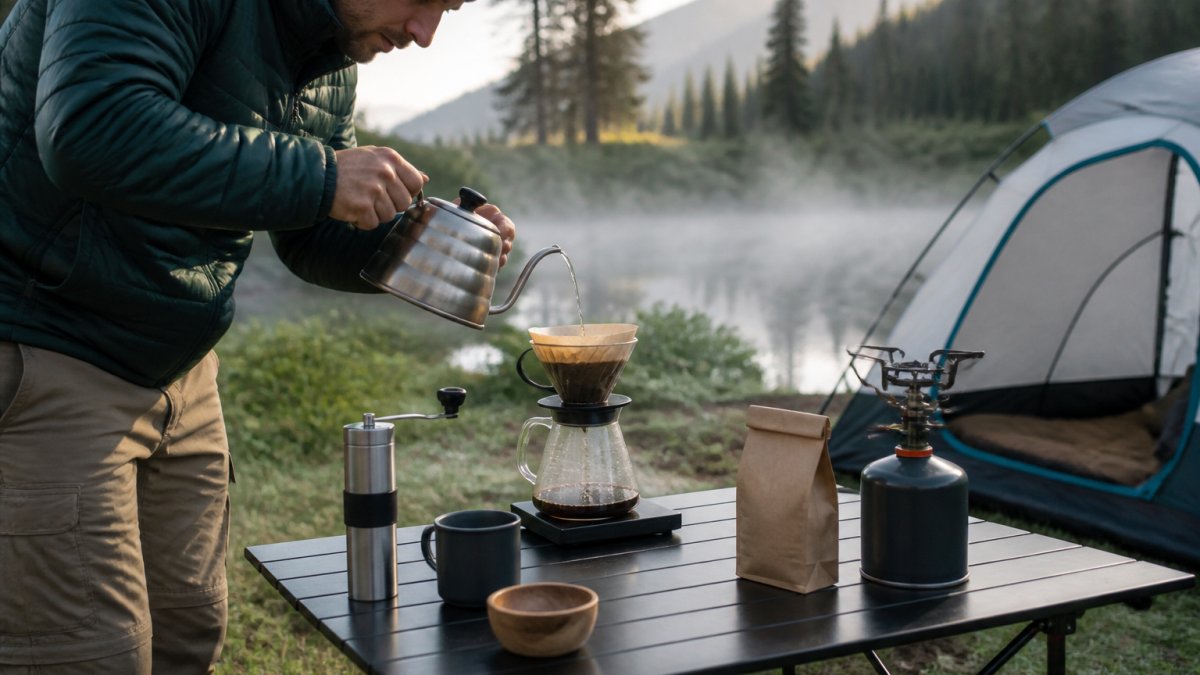
Pour-over is the lightest brewing method that produces good coffee. A collapsible silicone pour-over cone weighs less than two ounces and folds flat.
French press makes excellent coffee but is heavier and requires more cleanup. A small stainless steel French press weighs around eight ounces, steeps for four minutes, and produces four to six cups.
AeroPress is a middle ground. It weighs about four ounces, produces one to two cups of strong coffee, and uses paper filters so cleanup is clean. Brewing takes two minutes.
Percolator is the traditional camp coffee method. A metal percolator sits on your camp stove and brews as it heats.
Single-serve sachets are pre-portioned brewing packets that you pour hot water into and let steep. They're convenient, they're packable, and they eliminate the need for a brewing device.
Camping Coffee Maker Options: Lightweight and Durable
The best camping coffee maker is the one you'll actually use. If you hate fiddling with equipment, a simple pour-over or instant coffee beats a fancy setup you resent carrying.
For ultralight backpacking, a collapsible silicone pour-over cone (around two ounces) is the gold standard. It folds flat, it's durable, and it produces one to two cups of good coffee. Pair it with paper filters and you have a complete brewing system that weighs less than three ounces total.
For car camping, a small stainless steel French press (eight to twelve ounces) is hard to beat. It makes four to six cups, it's durable enough to last decades, and it produces rich coffee. The weight is irrelevant when you're driving to your campsite.
For motorcycle touring or minimalist trips, an AeroPress (four ounces) is the practical choice. It's more durable than a pour-over, it produces stronger coffee, and it's compact enough to fit in a small bag.
The key to any camping coffee maker is durability. Plastic breaks in a backpack; cheap metal rusts or dents. Invest in stainless steel or high-quality silicone that will survive rough handling for years of trips.
Coffee to Water Ratio for Camping: Getting the Strength Right
The standard ratio for brewed coffee is one part coffee to sixteen parts water by weight, roughly two tablespoons of ground coffee per six ounces of water.
In the field, you rarely have a scale, so use this simple rule: one rounded tablespoon of ground coffee per six-ounce cup of water. If you like stronger coffee, add another half-tablespoon.
For instant coffee, the ratio is simpler: one teaspoon per six-ounce cup of hot water. Stir until fully dissolved. Taste it and adjust on your next cup.
Water temperature matters. Ideal brewing temperature is 195 to 205 degrees Fahrenheit.
At high altitude, water boils at a lower temperature. At 5,000 feet it boils at around 202 degrees, actually ideal for coffee (Facts About Water). Brewing may take slightly longer, but the coffee will taste fine.
Hot Chick Coffee's single-origin roasts like Peru and Brazil Santos are designed to highlight the specific characteristics of each region. Peru has citrus and caramel notes that shine when brewed at the right ratio.
Waste and Leave-No-Trace: Packing Out Your Coffee
The Leave No Trace principle requires you to pack out everything you pack in. For coffee, that means dealing with grounds, filters, and packaging responsibly.
Paper filters are the best option for environmental impact. The best practice is to pack them out. They weigh almost nothing.
Reusable metal filters are better for repeated use. You can rinse them at camp and pack them out wet, they'll dry on the trail.
Coffee grounds should be packed out or buried properly. Never leave grounds around your campsite because they attract animals.
Instant coffee produces no grounds, which is one reason ultralight backpackers prefer it. You just mix it into your cup, drink it, and rinse the cup. No waste to deal with.
For packaging, buy coffee in bulk and portion it into small ziplock bags before your trip. This eliminates packing out large bags, reduces weight, and leaves less trace.
Choosing the best coffee for camping trips comes down to matching your brewing method to your trip style and weight constraints.
Hot Chick Coffee's fresh-roasted beans are designed for adventurers who don't want to compromise on quality. Whether you choose the Cowboy Blend for its bold, balanced flavor or a single-origin like Sumatra for its earthy complexity, fresh-roasted coffee will improve your camp experience.
Frequently Asked Questions
What is the best coffee to take camping?
The best coffee for camping depends on your trip style and priorities. For backpacking, instant coffee or lightweight whole beans minimize weight and pack size. For car camping, fresh-roasted ground coffee delivers superior flavor and aroma. Single-origin coffees like Peru or Brazil Santos offer complex tasting profiles, while blends like Cowboy Blend provide bold, consistent flavor. Consider brew time, cleanup requirements, and how much weight you're willing to carry when choosing.
Is instant coffee or ground coffee better for camping?
Instant coffee wins on convenience, weight, and cleanup, dissolve it in hot water and you're done. Ground coffee requires a brewing method (pour-over, French press, or AeroPress) but delivers superior flavor, aroma, and freshness. For backpacking where weight matters, instant is practical. For car camping or base camps where you have more space, ground coffee rewards you with noticeably better taste. Many campers bring a sample pack to test multiple roasts and decide which trade-off suits them best.
How do you make good coffee while camping?
Start with fresh-roasted beans or quality instant coffee. Use the correct coffee-to-water ratio: roughly 1 to 2 tablespoons of ground coffee per 6 ounces of water, depending on your taste preference. Boil water to 195-205 degrees Fahrenheit, let it cool 30 seconds after boiling if you can't measure temperature. Choose a brew method suited to your gear: pour-over takes 3-4 minutes, French press takes 4 minutes, AeroPress takes 1-2 minutes. Let water cool slightly before drinking to avoid burns on the trail.
How much coffee should you bring on a camping trip?
Plan for one serving per person per day, plus one extra. A typical serving is 6-8 ounces of brewed coffee, which requires about 0.5 ounces of ground coffee or one instant coffee packet. For a 3-day trip with two people, bring about 3-4 ounces of ground coffee or 6-8 instant packets. Consider your camp style: base camps allow heavier, fresher whole beans, while backpacking trips benefit from lightweight instant or pre-measured packets.
What brewing method is easiest to clean while camping?
Instant coffee requires no cleanup, just stir into hot water. Pour-over systems need a quick rinse of the dripper and filter. AeroPress is compact and cleans easily with a quick plunge of water. French press requires more scrubbing to remove grounds from the mesh filter. Single-serve coffee sachets eliminate cleanup entirely but cost more per serving. For leave-no-trace camping, pack out all grounds and filters. Instant coffee and sachets are ideal for minimizing water use and waste on the trail.

0 comments