
Table of Contents
- What You'll Need to Brew Fresh Coffee at Home
- The Best Coffee Brewing Methods for Beginners
- Step-by-Step: How to Brew Fresh Coffee at Home (Beginner Recipe)
- Coffee-to-Water Ratio for Brewing: Measure for Consistency
- How to Grind Coffee Beans for Brewing
- How to Store Coffee Beans for Lasting Freshness
- Troubleshooting by Taste: Fix Sour, Bitter, or Weak Coffee
- Frequently Asked Questions
Last Updated: October 16, 2026
What You'll Need to Brew Fresh Coffee at Home
Learning how to brew fresh coffee at home comes down to four things: good beans, the right grind, clean water, and a method you'll actually use every morning. This guide from Hot Chick Coffee walks you through each one.
Here's the core idea: fresh coffee is coffee brewed from whole beans ground shortly before brewing, using water just below boiling. Older grounds and boiling water both flatten the flavor.
Essential Equipment for Beginners
A grinder, a scale, a kettle, and one brewing device cover 90% of home setups.
- Burr grinder - gives you even grind size, which controls how your coffee tastes
- Digital scale - measures beans and water by weight, not by scoop
- Kettle - a gooseneck spout helps with pour-over, a standard one works for the rest
Skip the espresso machine for now. It's the hardest method to learn and the least forgiving.
Fresh Beans and Filtered Water
Beans matter more than gear: a basic setup with fresh beans beats a fancy setup with stale ones.
Buy whole beans, not pre-ground, and check for a roast date rather than a "best by" date. Use filtered water, since tap minerals and chlorine dull the flavor before the coffee even hits your cup.
The Best Coffee Brewing Methods for Beginners
The best brewing method for beginners is the one that fits your morning: pour-over for the cleanest cup, French press for the boldest, drip for the easiest, AeroPress for the most control in the smallest footprint.
Here's how the four popular home brewing methods compare:
| Method | Time | Grind | Best For | Cleanup |
|---|---|---|---|---|
| Pour-over | 3-4 min | Medium-fine | Clean, bright flavor | Rinse filter |
| French press | 4-5 min | Coarse | Bold, full body | Rinse plunger |
| Drip maker | 5-8 min | Medium | Hands-off mornings | Swap filter |
| AeroPress | 2-3 min | Medium-fine | Fast, strong single cups | Rinse and go |
Pour-Over, French Press, Drip, and AeroPress Compared
French press is the opposite. The grounds steep fully in water, so you get more oils and a heavier body.
Drip coffee makers do the work for you. Look for a showerhead spray and a thermal carafe, since a hot plate scorches coffee after 20 minutes.
AeroPress is a favorite for travel and camping: a strong, smooth cup in about two minutes, packed down small.
Step-by-Step: How to Brew Fresh Coffee at Home (Beginner Recipe)
Master this pour-over first; it works with any medium roast.
Total time: 8 minutes (including a 4-minute brew) Difficulty: Beginner You'll need: 22 g whole beans, 350 g filtered water, a burr grinder, a scale, a kettle, and a pour-over dripper with a paper filter.
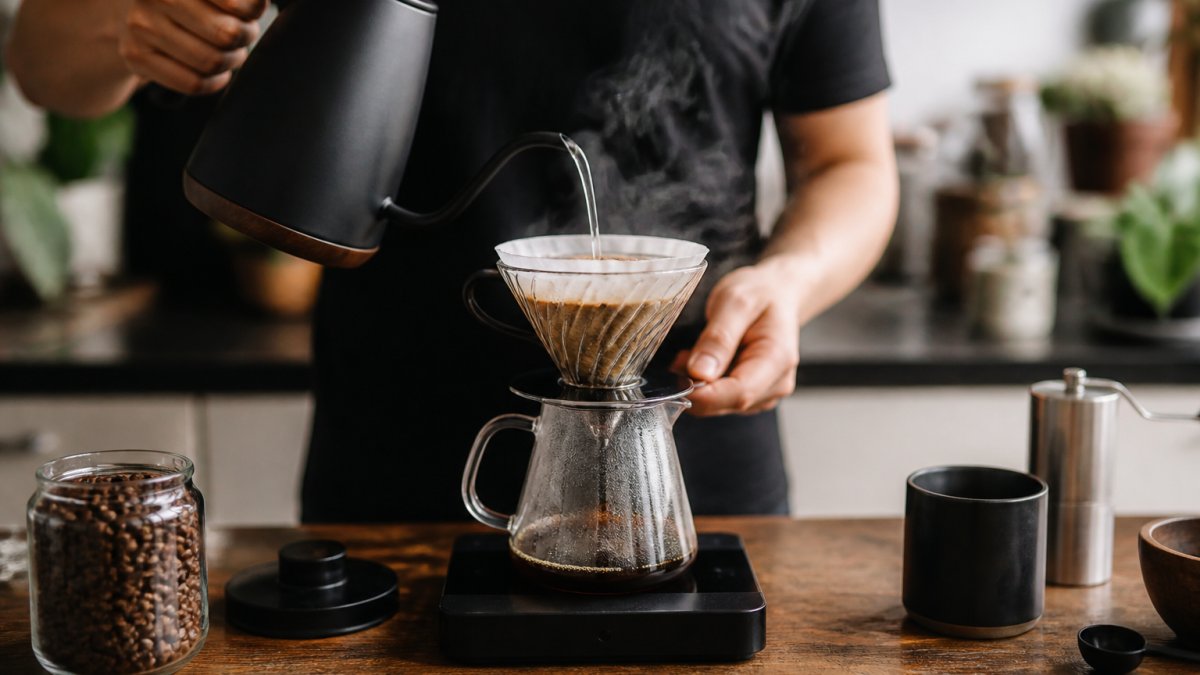
The 1:16 Coffee-to-Water Ratio Made Simple
- Heat your water to 200°F. Let it sit for 30 seconds after boiling. Boiling water burns the grounds.
- Weigh 22 g of beans and grind them medium-fine. You want the texture of table salt.
- Rinse the paper filter with hot water. This removes paper taste and warms your cup.
- Add the grounds and start your timer. Pour 60 g of water to wet everything. Wait 30 seconds.
- Pour in slow circles. Add water in three stages until you hit 350 g total.
- Let it drain fully. The whole brew should finish between 3 and 4 minutes.
- Swirl the cup and taste. Adjust your grind next time based on what you taste.
Expected result: A balanced cup with clear flavor and no grit. If it's sour or bitter, see the troubleshooting section below.
Coffee-to-Water Ratio for Brewing: Measure for Consistency
The coffee-to-water ratio for brewing is the single biggest lever you control. Most beginners use too little coffee and too much water, which is why home coffee often tastes thin.
What the Ratio Actually Controls
The ratio sets your starting strength before extraction begins. More water per gram of coffee means more dilution and a thinner body; less water means a denser, heavier cup. Grind size and brew time decide how much flavor the water pulls out, but the ratio decides how much room there is to pull into.
You can't fix a bad ratio with grind alone: brewing 15 g of coffee into 400 g of water will never taste full, no matter the grind setting.
A Simple Starting Range
- 1:15 - stronger, good for dark roasts and milk drinks
- 1:16 - the standard starting point for most beans
- 1:17 - lighter, good for delicate single-origin beans
Weigh both coffee and water. Volume scoops vary too much, a level scoop of fine grounds can weigh nearly twice what a scoop of coarse grounds does.
How to Scale the Ratio to Any Mug
Once you pick a ratio, scaling is simple: multiply your coffee dose by the ratio to get your water weight.
| Coffee | Ratio | Water | Roughly Yields |
|---|---|---|---|
| 15 g | 1:16 | 240 g | One small mug |
| 22 g | 1:16 | 350 g | One large mug |
| 30 g | 1:16 | 480 g | Two small mugs |
| 45 g | 1:16 | 720 g | A small carafe |
At 1:16, water weight is always 16 times the coffee weight; at 1:15, multiply by 15, and at 1:17, by 17.
When to Move the Ratio
Change the ratio only after grind and time are dialed in. If flavor is correct but the cup is too weak or strong, the ratio is your lever; if it tastes sour or bitter, fix grind first.
- Too weak but flavor is clean: drop the water by 10-15 g or add 1 g of coffee.
- Too strong but flavor is clean: add 15-20 g of water.
- Flavor is off, not just strength: leave the ratio alone and adjust grind.
Once you find your ratio, write it down. Repeatability is what separates a good cup from a lucky one.
How to Grind Coffee Beans for Brewing
Grind size controls how fast water pulls flavor from the grounds: too fine gives bitterness, too coarse gives a weak, sour cup.
Match your grind to your method:
- Coarse - French press
- Medium - drip coffee maker
- Medium-fine - pour-over and AeroPress
Grind right before you brew: ground coffee loses aroma within minutes, while whole beans hold their flavor for weeks. If your grinder has settings, start in the middle and adjust one notch at a time.
How to Store Coffee Beans for Lasting Freshness
Most storage advice stops at 'airtight, dark, cool.' What actually matters is what happens to the beans after you open the bag, because that's when the clock really starts.
What's Actually Happening Inside the Bag
Roasted coffee releases carbon dioxide for days after roasting, why a freshly opened bag puffs and why a valve matters. That off-gassing also makes very fresh coffee brew oddly, since CO2 pushes water away from the grounds.
After that, oxygen reacts with the bean surface oils and stales them, light breaks down those same oils, heat accelerates both reactions, and moisture invites them.
Practical Storage That Actually Works
- Keep the bag's one-way valve if it has one. It lets CO2 escape without letting oxygen in. A plain jar doesn't do this.
- Squeeze the air out before sealing. Less headspace means less oxygen in contact with the beans.
- Store in an opaque, airtight container, a ceramic canister with a gasket, a vacuum-sealed canister, or the original bag rolled tight and clipped. A clear glass jar on a sunny counter is the worst common choice.
The Freezer Question, Answered Properly
Blanket freezing advice is wrong in both directions, it depends on how long you're storing.
- Daily-use beans (finishing within two weeks): keep them at room temperature. Every time you pull the bag out and put it back, condensation forms on the cold beans, and that moisture stales them faster than the freezer saves them.
- Bulk beans (more than two weeks out): portion into week-sized amounts, seal each portion airtight, and freeze. Take out one portion at a time and let it come to room temperature before opening the seal. This keeps the untouched portions genuinely fresh.
The mistake isn't freezing, it's freezing and thawing repeatedly.
Freshness Cues You Can Actually Use
You don't need a lab to tell if beans are past their prime. Watch for these:
- No aroma when you open the bag. Fresh beans smell strongly of the roast. Flat smell, flat cup.
- Beans look dry and matte. Fresh beans have a slight sheen from surface oils. Very dry, dusty-looking beans have lost them.
- The bloom is weak. When hot water hits fresh grounds, they swell and bubble. If your pour-over barely blooms, the beans have already released most of their CO2.
Buy fresh, store smart, and finish the bag before it goes flat. Everything else in this guide depends on that.
Troubleshooting by Taste: Fix Sour, Bitter, or Weak Coffee
Your taste buds are the best diagnostic tool you have.
| What You Taste | Likely Cause | The Fix |
|---|---|---|
| Sour, sharp | Under-extracted | Grind finer or brew longer |
| Bitter, dry | Over-extracted | Grind coarser or shorten brew |
| Weak, watery | Too little coffee | Add beans or cut water |
| Flat, stale | Old grounds | Grind fresh, buy fresher beans |
Change one variable at a time.
Sour coffee usually means the water moved through too fast. Bitter coffee means it sat too long.
Keep a simple log for a week. Note your grind, ratio, and how it tasted.
Brewing fresh coffee at home is a skill, and like any skill it rewards a little practice.
That's where we come in. Our Best Sellers Sample Pack lets you try six roasts for $24.99 before committing to a full bag, and our Peru single origin brings salted caramel and citrus notes that shine in a pour-over.

Frequently Asked Questions
What is the best way to make fresh coffee at home?
The best way depends on your routine. A drip coffee maker is easiest for large batches, while a pour-over or French press gives you more control over flavor. No matter which you choose, start with whole beans, grind them right before brewing, and use filtered water heated just below boiling. A simple 1:16 coffee-to-water ratio by weight works well for most methods and keeps your results consistent.
How many scoops of coffee should I put in a coffee maker?
For a standard 12-cup drip coffee maker, use about 2 tablespoons of ground coffee per 6 ounces of water. That is roughly 1 to 2 tablespoons per cup, depending on how strong you like it. Weighing your coffee with a kitchen scale is more accurate than scoops, but if you are in a hurry, a level tablespoon per cup is a reliable starting point. Adjust from there to taste.
Should I grind coffee beans right before brewing?
Yes. Grinding right before brewing preserves the aromatic oils that give coffee its flavor. Pre-ground coffee loses those oils quickly, so the cup tastes flatter. A burr grinder gives you a consistent grind size, which helps extract flavor evenly. For pour-over, use a medium-fine grind; for French press, a coarse grind; for drip, a medium grind. Freshly ground beans make a noticeable difference in the cup.
How should I store coffee beans to keep them fresh?
Keep whole beans in an airtight container away from light, heat, and moisture. A dark cabinet works better than a countertop jar. Do not refrigerate or freeze unless you plan to store beans for more than a month; if you do freeze, use a sealed bag and let beans come to room temperature before grinding. Buy in small batches so you finish them within two to four weeks of the roast date. Whole beans stay fresh longer than ground coffee.
0 comments